Generate
Competing hypotheses
Ask for alternative explanations, edge cases and questions you have not considered.

AI increasingly mediates what reaches us as information. Reality Skill uses it as a subordinate critical layer without silently outsourcing judgment. The Founding Reality Lab starts by establishing a human baseline, then measures where AI genuinely improves the process.
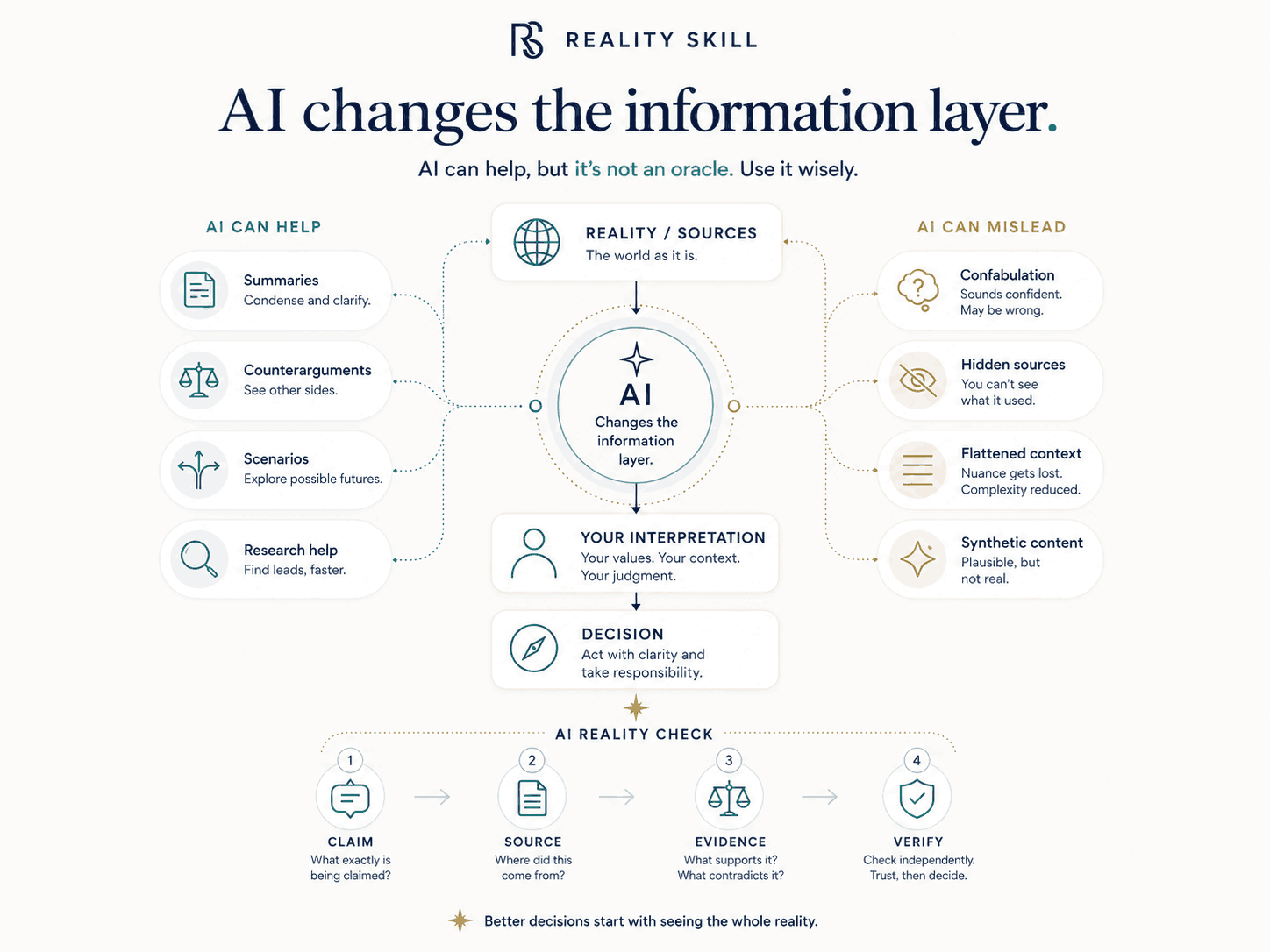
Ask for alternative explanations, edge cases and questions you have not considered.
After you record your own reasoning, ask AI to find unsupported assumptions, missing base rates and disconfirming evidence.
Map a domain quickly, then follow decision-relevant claims back to primary or independent sources.
Local transcription, memory retrieval and a live process dashboard remain research modes rather than promises of the founding cohort.
Separate fact, inference, recommendation and generated hypothesis.
Can the important claim be traced to primary data, an official record or credible independent evidence?
Who created the underlying information, and what do they gain from the framing?
Generate the best competing explanation, then look for evidence that distinguishes the models.
Leave the answer and check independent sources rather than judging credibility from presentation quality.
If the claim cannot change the decision, stop spending attention. If it can, raise the verification standard.
Establish the human baseline first. Learn what structured independent judgment and the Scored Journal accomplish before attributing any improvement to AI.
Test AI red team or a local process copilot against the human baseline. Log interventions, contest them, and retain them only if they demonstrably add value.