AI & Information · Research direction

AI can make you faster. It can also make a wrong model feel complete.

AI increasingly mediates what reaches us as information. Reality Skill uses it as a subordinate critical layer without silently outsourcing judgment. The Founding Reality Lab starts by establishing a human baseline, then measures where AI genuinely improves the process.

Current operating rule: Protocol v1.2 is run human-only in the founding cohort. AI red teaming, private/local transcription and live copilots remain research hypotheses until a human baseline exists.
research modehuman-firstverificationAI is not the founding group process
AI and the information layer

More fluent output does not remove the need for judgment.

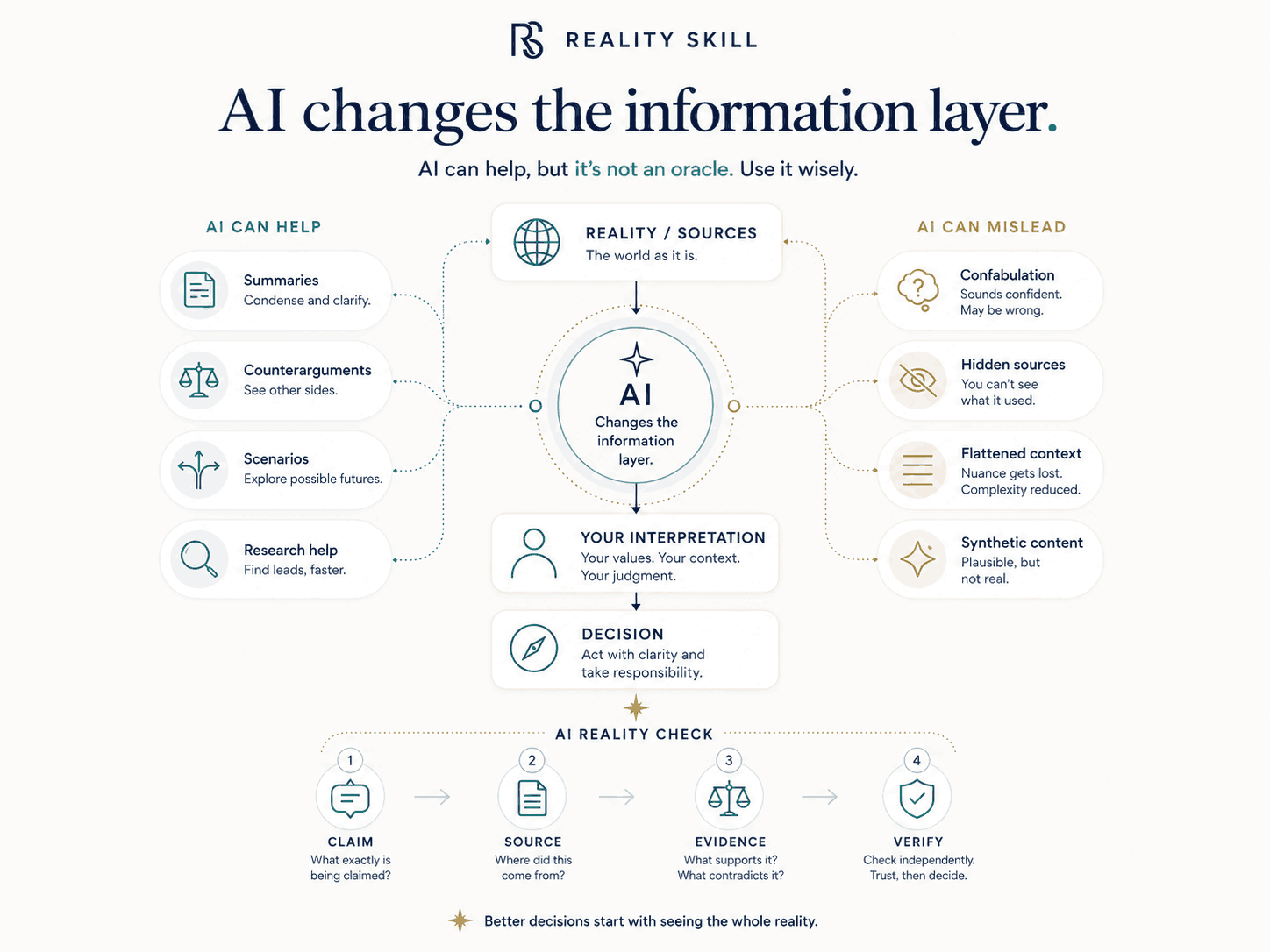
AI changes the information layer diagram
Open the illustration to view it full size.
Why this matters

AI changes the path between reality and your decision.

Underlying realityEvents, people, systems, primary data, physical constraints.
Information layerPublishers, search, communities, algorithms and source incentives.
AI-mediated contextSummaries, generated explanations, recommendations, synthetic content and agents.
Your modelWhat you believe happened, why, and what matters.
Your decisionAction, commitment, update trigger and later outcome.
A fluent AI answer is an information event. It is not automatically evidence.
Useful jobs

Use AI where abundant cognition helps without granting it automatic authority.

Generate

Competing hypotheses

Ask for alternative explanations, edge cases and questions you have not considered.

Challenge

Red-team a human-first view

After you record your own reasoning, ask AI to find unsupported assumptions, missing base rates and disconfirming evidence.

Compress

Reduce search cost

Map a domain quickly, then follow decision-relevant claims back to primary or independent sources.

Research later

Private/local tools

Local transcription, memory retrieval and a live process dashboard remain research modes rather than promises of the founding cohort.

AI Reality Check

Six questions before an AI answer is allowed to materially change an important decision.

01

What is the claim?

Separate fact, inference, recommendation and generated hypothesis.

02

Where did it come from?

Can the important claim be traced to primary data, an official record or credible independent evidence?

03

What incentives shaped the source?

Who created the underlying information, and what do they gain from the framing?

04

What is the strongest alternative?

Generate the best competing explanation, then look for evidence that distinguishes the models.

05

Can I verify laterally?

Leave the answer and check independent sources rather than judging credibility from presentation quality.

06

Would this change my action?

If the claim cannot change the decision, stop spending attention. If it can, raise the verification standard.

Research sequence

AI should earn its place in the protocol.

Now

Human baseline first

Establish the human baseline first. Learn what structured independent judgment and the Scored Journal accomplish before attributing any improvement to AI.

Later

Measure marginal value

Test AI red team or a local process copilot against the human baseline. Log interventions, contest them, and retain them only if they demonstrably add value.

Research, not product promise

AI increases the supply of answers. Reality Skill should improve the quality of contact with evidence.