Weeks 1–4
Four closer meetings
Learn the protocol, establish confidentiality norms, practice private-first judgment and work on real cases.
A small human-first system for better consequential decisions - designed to use meetings only where a live room adds more value than a simpler process.
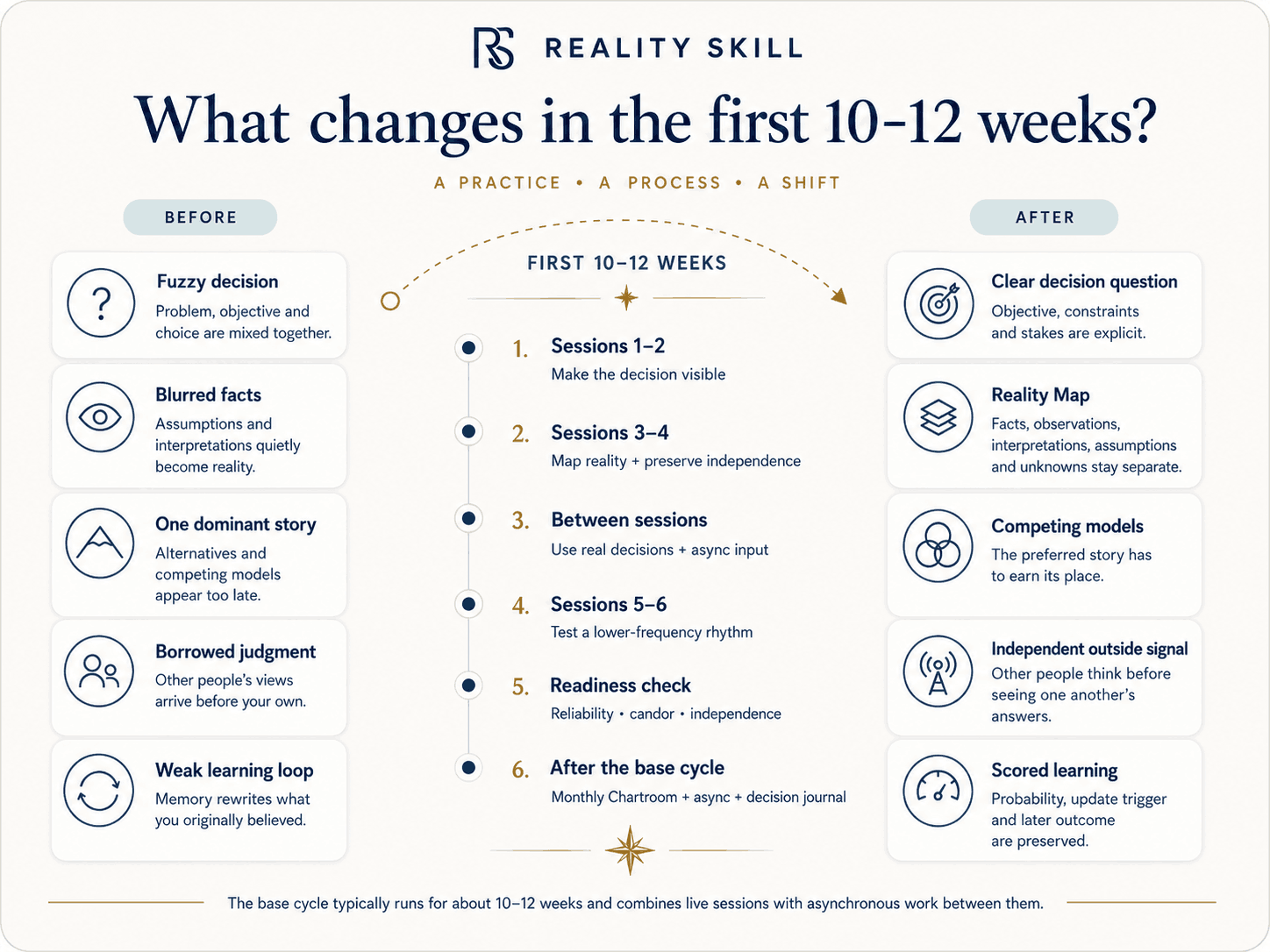
A normal mastermind puts the meeting at the center. Reality Skill does the opposite.
If an inexpensive method resolves the question, we stop. The room is reserved for decisions where independent responses reveal valuable disagreement, competing models, missing information or a framing problem.
The Foundation is not a twelve-topic course. Its job is to build the habits, trust and reliability that make lower-burden async work possible later.
Learn the protocol, establish confidentiality norms, practice private-first judgment and work on real cases.
Async panels start carrying real decisions while the group tests whether trust and reliability persist between meetings.
The founding cohort first establishes what the human protocol can do. AI can then be tested as a separate red-team layer after members record independent positions, with its contribution measured against that baseline.
Important decisions receive an initial estimate, action, review date and later outcome.
At the end of Foundation, the group moves to cruise only when three conditions are actually working.
The group can carry async responsibility without the facilitator chasing every answer.
Members do not remove information whose absence would materially distort the group’s judgment.
Members preserve their own view and contribute unique information, competing models or genuine dissent when it exists.
This is the minimum personal-contact rhythm of Protocol v1.2, not a temporary inefficiency to optimize away.
The capacity limit protects attention. Not every important question deserves seven other people.
Usually about 10–15 minutes each.
The live room focuses on the most valuable residual uncertainty rather than taking cases by rotation.
Planned, expected, but not policed. Trust needs contact that is not another framework.
The owner updates, decides and sets a review date. No synchronous meeting.
Stop discussing. Get the information, run the test or verify the assumption first.
Meaningful spread, competing models, tacit experience or framing problems make the case a Chartroom candidate.
Open earlier decisions and predictions. What did reality actually do?
Fresh observations from the parts of reality each member directly sees.
Why did competent independent judgments disagree? What unique information or model explains the spread?
Private final estimates, owner decision, review point and one short process review.
If the group needs more than one Emergency Mini-Room in a month for two months in a row, the Router/cadence is reviewed. The exception is not allowed to quietly recreate weekly meetings.
You respond when a serious case deserves your attention.
Not every detail - but enough that the group is not reasoning from a sanitized fiction.
You form your view before seeing the room and update when evidence warrants it.
Different domains, environments, first-hand experience and information sources matter.
Confidentiality is a participation condition, not an aspirational value.
A changed mind after better evidence is a successful outcome.
We select for reliability, candor, independent judgment, distinct first-hand experience, good faith and ability to update. Participation format is a practical constraint, not the purpose of the group.
Step 1 of 3Your decision