Reality Skill / Model Library

A model is a tool.
Not reality.

The question is not whether a model sounds intelligent. The question is: what part of reality is it good at seeing, what does it miss, and how can we test what it predicts?

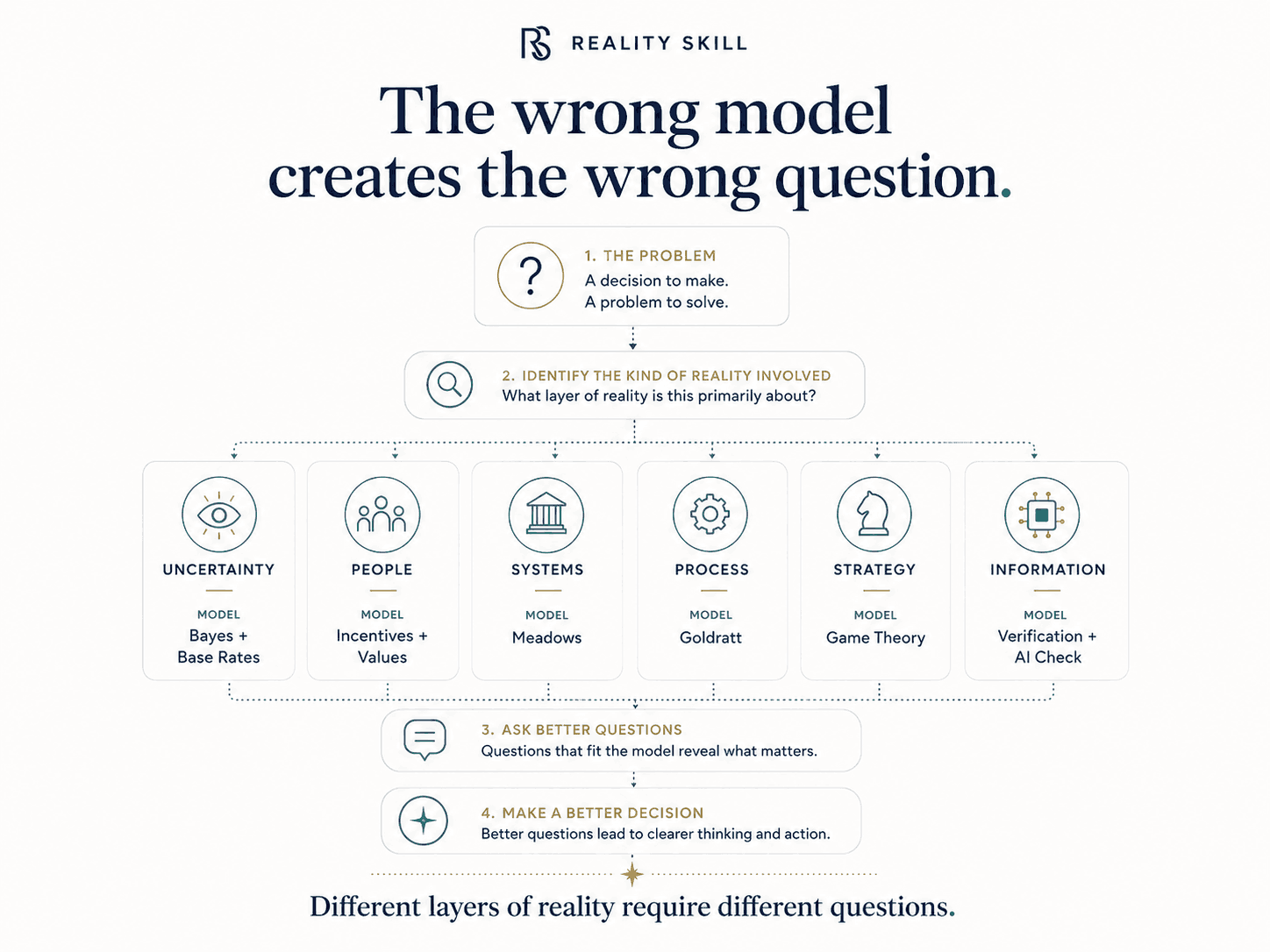
The wrong model creates the wrong question diagram
Use models for the jobs they are good at, and make their limits explicit.

The most dangerous model is often a useful model applied where it does not belong.Reality Skill is partly knowing which tool to reach for, and when to put it down.

Models do different jobs.

A forecasting model, a human-values lens and a systems map should not be judged as if they were interchangeable. First identify the job. Then choose the tool.

See

What is true?

Scientific method, Bayes, causal inference, forecasting.

Explain

What is generating it?

Systems, constraints, incentives, values, games.

Decide

What should I do?

Alternatives, opportunity cost, information value, robustness.

Challenge

What am I missing?

Red team, inversion, AQAL, de Bono, premortem.

Use the library in this order

Start with the decision. Identify what job needs to be done. Only then choose the model.

What we do not want

A library of clever labels. Every model should create a better question, a prediction, or a choice.

Model Library

Different models for different layers of reality.

This library is arranged by job, not prestige. The goal is not to collect smart-sounding frameworks. The goal is to choose a tool that improves what you see, ask, decide or verify.

01 / Truth & calibration

Use these when the main question is what to believe.

These are the most foundational models in Reality Skill. They help replace intuitive certainty with testable beliefs, calibrated confidence and clearer causal thinking.

If you miss this layer: you may reason elegantly from a belief that was never stress-tested in the first place.
Core

Scientific Method

How could I discover that I am wrong?

Turn beliefs into hypotheses, define what would count against them, test, and update.

Best for: escaping stories that feel true but were never actually challenged.
Combine with: Bayes, forecasting and causal reasoning.
Failure mode: calling an explanation a test. A real test must be able to surprise you.
Core

Bayesian Updating

What should this evidence do to my confidence?

Start with what was plausible before, weigh new evidence, and update proportionally instead of jumping from certainty to certainty.

Failure mode: precise-looking numbers built on invented assumptions.
Core

Causal & Counterfactual Reasoning

What is actually causing what?

Separate correlation from intervention. Ask what would likely have happened if the supposed cause had not occurred.

Failure mode: a coherent story that cannot distinguish competing causes.
Core

Forecasting & Calibration

How confident am I, as a number?

Make testable probability estimates, score them against outcomes, and learn whether your 70% really behaves like 70%.

Failure mode: vague predictions that can be reinterpreted after the fact.
Core

Reference Classes / Outside View

What usually happens in situations like this?

Before explaining why your case is special, look at comparable cases and their base rates.

Failure mode: choosing a reference class only because it supports the desired answer.
02 / Decision quality

Use these when the question is what to do next.

Decision models matter once alternatives are real, resources are limited and uncertainty remains. Their job is not to predict perfectly, but to improve the action chosen now.

Common mistake: research and analysis continue long after they have stopped being decision-relevant.
Core

Opportunity Cost

Compared to what?

A choice is not good in isolation. Compare it with the best realistic alternative, including doing nothing.

Best for: stopping “good sounding” options from avoiding comparison.
Watch for: hidden tradeoffs in time, energy, reputation and focus.
Failure mode: evaluating an option without naming the alternative it displaces.
Core

Value of Information

Could knowing this change my decision?

Research only the uncertainties capable of changing the action. More information is not automatically more value.

Failure mode: research as procrastination or anxiety management.
Core

Inversion + Premortem

Assume this failed. What probably caused it?

Attack the plan before reality does. Invert the goal and identify failure modes, hidden dependencies and preventable stupidity.

Failure mode: turning risk discovery into paralysis instead of better design.
03 / Systems & leverage

Use these when events repeat and local fixes do not hold.

When the same problems return, the explanation is often structural. These models help you move from isolated events to constraints, feedback loops and leverage points.

Reality Skill question: if we changed the person but kept the structure, would the same pattern eventually return?
Core

Systems Thinking / Meadows

What structure keeps producing this pattern?

Look for feedback loops, delays, stocks, flows, rules, information and leverage points behind recurring events.

Best for: recurring behavior that keeps resurfacing despite effort.
Combine with: Goodhart, constraints and explicit system boundaries.
Failure mode: beautiful system maps with no testable implication or action.
Core

Theory of Constraints / Goldratt

What constraint limits the whole system?

Complexity often contains leverage. Find the bottleneck that governs throughput before optimizing everything else.

Failure mode: assuming every situation has one stable bottleneck.
Core

Goodhart / Campbell

If we optimize this metric, could we damage the real goal?

Metrics reshape behavior. Distinguish the thing you care about from the proxy you happen to measure.

Failure mode: treating a convenient KPI as the objective itself.
Core

Fermi Decomposition

Which smaller unknowns actually determine the answer?

Break a huge uncertain question into estimable parts. Often one or two variables dominate the result and tell you what to research.

Failure mode: false precision instead of identifying order of magnitude and leverage.
04 / People, culture & strategic interaction

Use these when other people are part of the reality you are modelling.

Human behavior rarely has one cause. Incentives, values, identity, personality, culture and strategic interaction all matter. The goal is better hypotheses, not faster labeling.

If you miss this layer: you may correctly analyze the economics and still mispredict what the people involved will actually do.
Core

Incentives

What behavior is this system rewarding?

People respond to money, status, power, safety, convenience and social rewards, often more reliably than to stated intentions.

Best first question: what changes for them if they choose A versus B?
Do not forget: incentives are powerful, but not the whole human story.
Failure mode: assuming incentives explain everything and ignoring values, identity or constraints.
Evidence-backed lens

Schwartz Values

What does this person consider important enough to guide choices?

Use values as motivational hypotheses about priorities such as achievement, security, benevolence, autonomy and tradition.

Failure mode: predicting a specific action from one value while ignoring context.
Evidence-backed lens

Big Five

Which stable behavioral tendencies may matter here?

Personality traits can improve expectations about typical behavior, but situations still create substantial variation.

Failure mode: turning tendencies into destiny.
Hypothesis lens

Graves / Spiral Dynamics

What value system may be organizing this person's interpretation?

Useful for hypotheses about what feels legitimate, important, threatening or admirable. Treat the taxonomy as a lens, not ground truth.

Failure mode: “He is Orange, therefore he will do X.”
Coverage lens

AQAL / Four Quadrants

Which dimension of the situation are we not modelling?

Check individual interior, individual exterior, collective culture and collective systems before accepting a one-dimensional explanation.

Failure mode: treating a completeness map as a precise predictive theory.
Core

Game Theory & Signaling

How will they react to what they think I will do?

When actors respond strategically to one another, model incentives, information, credible commitments and repeated interaction.

Failure mode: assuming the payoff function instead of discovering what people actually care about.

05 / Adaptation, creativity & information

Use these when the world is changing, the problem type is unclear, or the information environment is suspect.

Some models help you move when certainty is impossible. Others help you generate alternatives or verify whether the inputs to your reasoning deserve trust in the first place.

Reality Skill rule: a powerful mind can still fail if the source material was wrong, the problem type was misclassified, or the frame was too narrow.
Core

OODA / Experimental Adaptation

What is the smallest action that gives me useful reality feedback?

Observe, orient, decide, act, then reorient as new evidence arrives. Learning speed can matter more than first-try perfection.

Best for: uncertain environments where waiting for certainty is itself costly.
Watch for: movement that creates activity without improving orientation.
Failure mode: moving fast without improving orientation.
Diagnostic lens

Cynefin

What kind of problem is this before we decide how to solve it?

Clear, complicated, complex and chaotic contexts demand different decision modes. Sometimes analysis is right; sometimes you need probes and adaptation.

Failure mode: forcing a messy problem into a neat category.
Generative lens

de Bono / Lateral Thinking

What if the framing itself is the problem?

Deliberately generate alternatives and change perspectives before optimizing inside the first frame that appeared.

Failure mode: generating novelty without a later truth test.
Core

Lateral Reading & Provenance

Who is behind this claim, and what independent evidence supports it?

Leave the source, inspect provenance, triangulate independent coverage, and trace claims back toward primary evidence.

Failure mode: evaluating credibility from how professional the page looks.
One rule for the whole library: every model should eventually produce either a better question, a testable prediction, a better option, or a decision-changing piece of information. If it only produces a clever story, treat it cautiously.

Knowing the model is not the skill.

The skill appears when you can use the right model on a consequential decision, then return later and see whether reality agreed.