Fact
Reasonably established
A claim supported well enough for the current decision context. Still open to correction if better evidence appears.

A decision can fail because we modeled the wrong layer - or because an observation, interpretation and assumption were all treated as the same thing. Reality Map checks both.
A claim supported well enough for the current decision context. Still open to correction if better evidence appears.
Who observed it? When? In what context? One observation is a signal, not automatically a general law.
An explanation placed on top of facts or observations. Useful - but not the same thing as what happened.
A dependency inside the model that has not yet earned fact status.
Something potentially decision-relevant that we do not currently know.
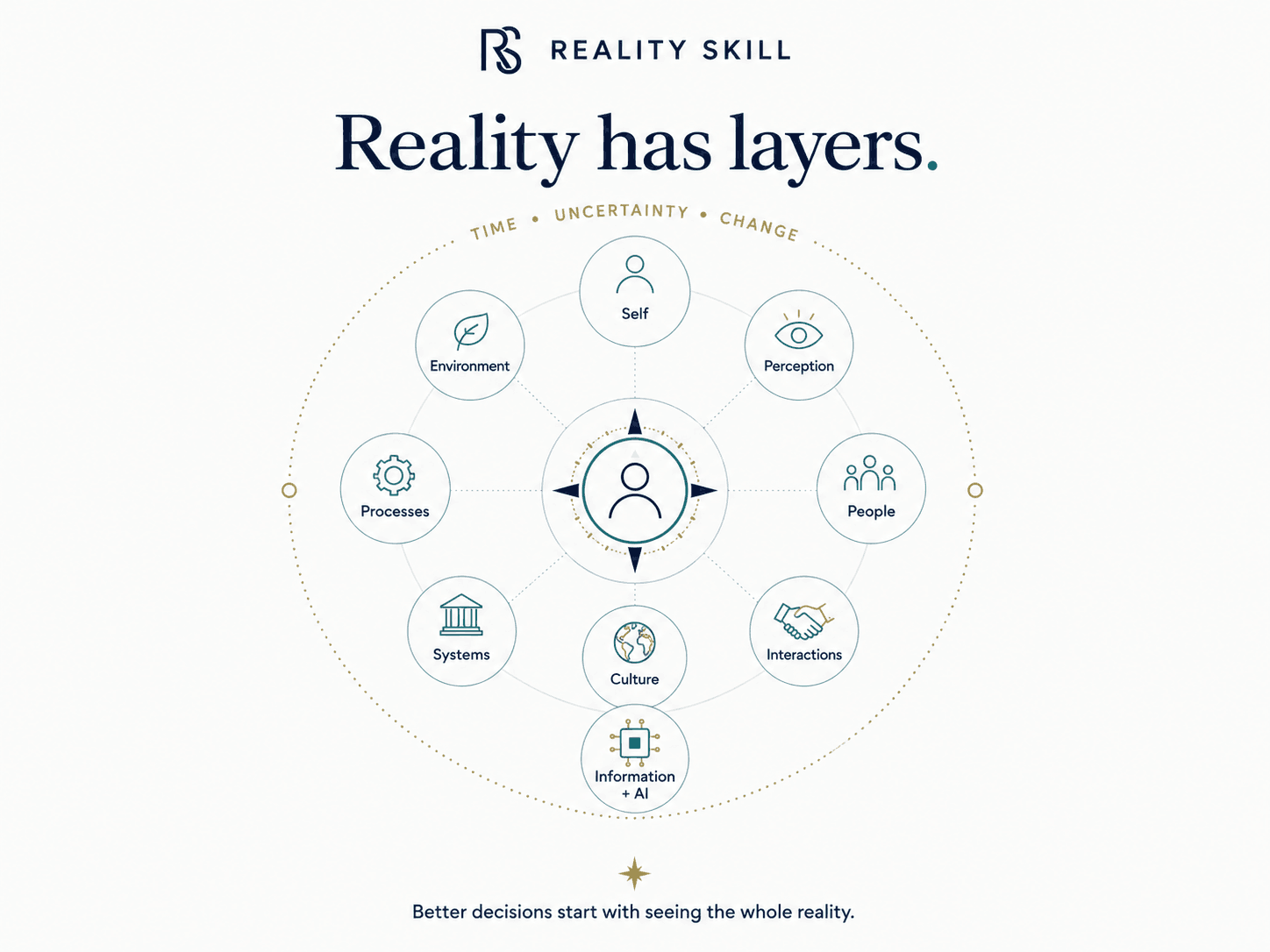
Goals, values, identity, emotional state, skill, energy, constraints and risk tolerance.
Attention, priors, assumptions, confidence and mental models shape what reaches you as “reality.”
Incentives, values, identity, status, beliefs, traits and temporary state.
What people do when they anticipate and react to one another.
Norms, legitimacy, shared stories, identity and social enforcement.
Feedback loops, delays, stocks, flows, rules, information flows and emergent behavior.
Flow, bottlenecks, queues, handoffs, variation and execution.
Economics, law, technology, physical constraints, competition, geography and risk.
Sources, incentives, algorithms, provenance, generated content and the context layer between events and your model.
A “people” statement can still be a fact, observation, interpretation, assumption or unknown. The matrix keeps those questions separate.
| Layer | Fact | Observation | Interpretation | Assumption | Unknown |
|---|---|---|---|---|---|
| People | Role / contract / KPI | “Three team members stopped escalating to him.” | “The team lost trust.” | “Trust is the main cause of the KPI miss.” | What do direct reports actually say privately? |
| Systems | Decision rights are documented | Approvals repeatedly return to the founder | The COO lacks authority | More authority would improve throughput | Which decisions are actually bottlenecked? |
| Environment | New regulation takes effect on date X | Competitors changed pricing | Market pressure is rising | Pressure will persist 12 months | How elastic is customer demand? |
Reality Skill asks where a signal came from: direct observation, personal experience, public evidence, another participant, second-hand report or intuition. Five similar estimates built on one report are not five independent pieces of evidence.
The Solo Decision Template combines epistemic type + reality layers with alternatives, outside view, competing models, premortem, private estimates and outcome review.
Once the map is explicit, the protocol can decide whether the next step is a rule, experiment, structured solo work, async human panel or Chartroom.