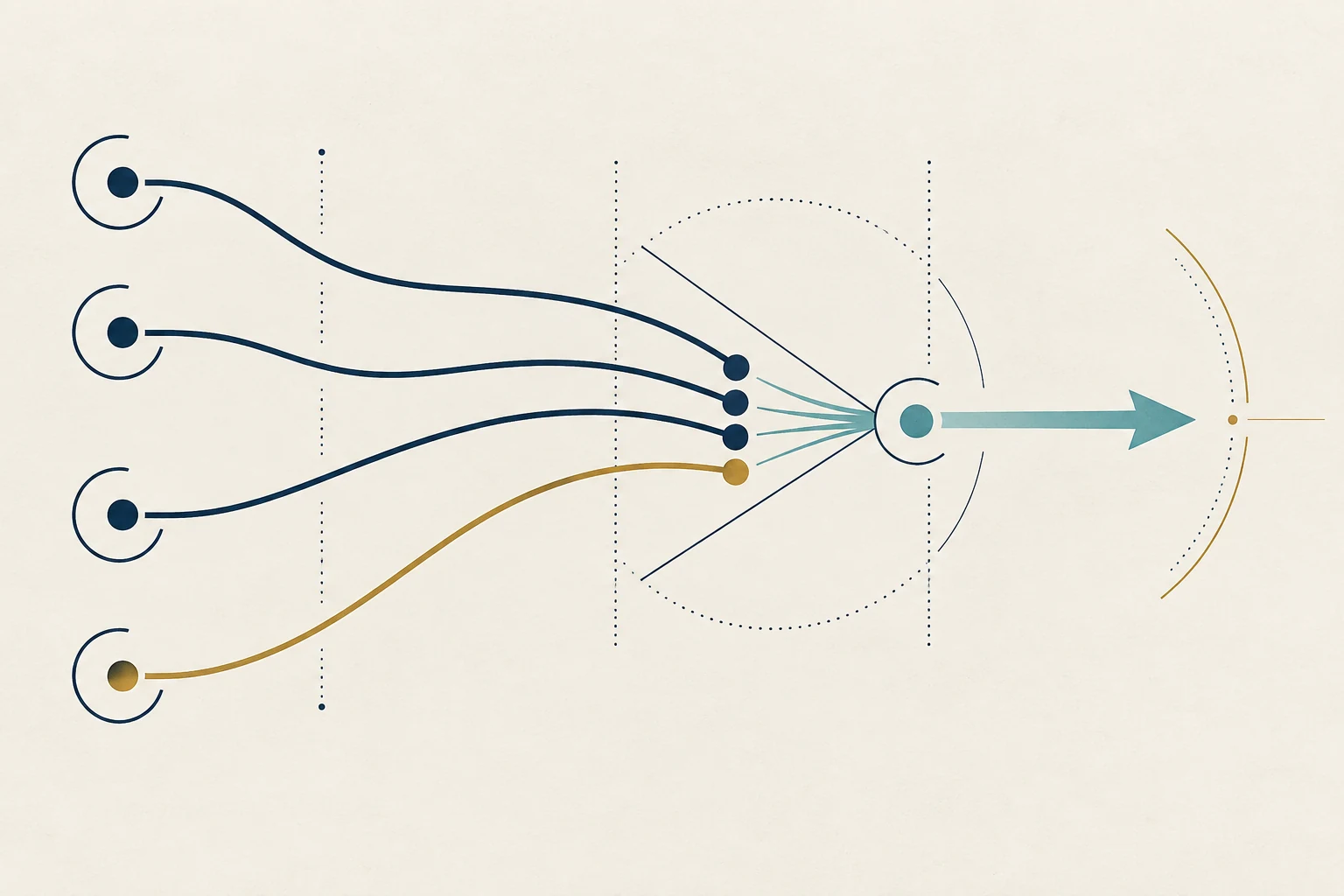
Hear what each person knows before the room converges.
Each participant records a reading, unique knowledge, a viable option, a key assumption, a prediction, confidence, the strongest disagreement, and what would change their mind.
For CEOs, business owners & leadership teams
Preserve independent thinking before group influence. Make decision rights and approvals explicit. Keep the company record through execution, personnel changes, and outcome review—without handing the final call to a vote or an AI black box.
Establish a decision standard your leadership team can use.
Independent first. Authority explicit. Assumptions monitored. Outcomes reviewed.
One accountable operating loop
Reality Skill keeps the team’s thinking, the company’s authority, and the eventual outcome connected. Leaders can see how a recommendation was formed without turning every consequential choice into a meeting, a vote, or an opaque AI answer.
Place the current decision version into an authorized company workflow.
Named participants contribute before anyone sees the group’s answers.
Compare differences, address dissent, and let the named owner make the call.
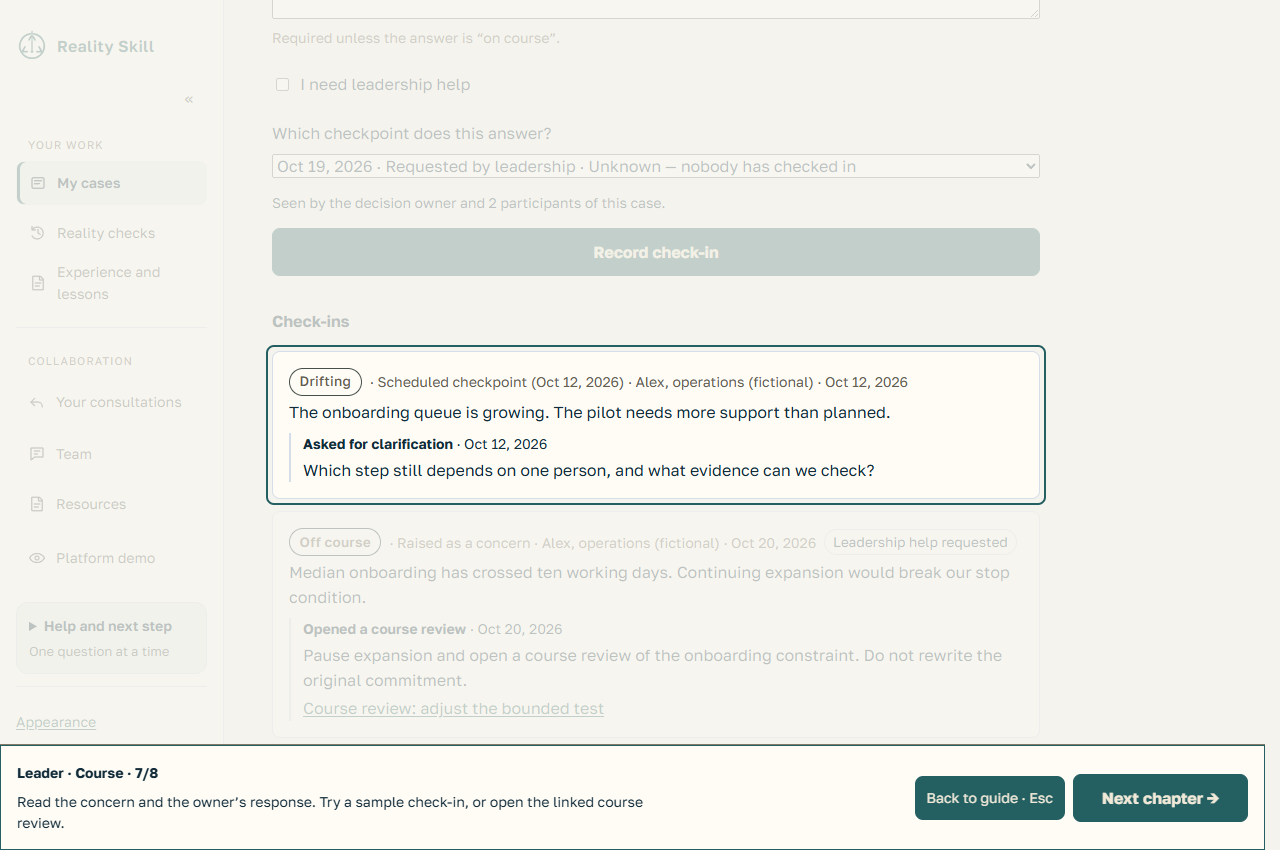
Set checkpoints, record quick check-ins, answer concerns, and open a linked course review when needed.
Compare forecasts with outcomes and carry useful lessons into later decisions.
Situation: the first confident opinion begins shaping the room before quieter participants disclose what they know.
Platform move: collect each person’s evidence, assumptions, prediction, concern, and alternative while contributions remain sealed.
Possible result: the team examines differences before the named owner commits. One dissenting contribution can remain visible even when the final direction differs.
Illustrative process · not a claim that software eliminates groupthinkSee whether the workflow fits your company. We will discuss the teams, decision types, governance, and rollout before quoting a licence.
Apply for a company pilotProtected feedback · accountable decisions
Independent input helps people think before the room influences them. Protected feedback adds a separate choice: an invited Team Room participant can raise a concern without attaching their name for teammates or company leaders to see.
Add a named or anonymous-to-team note alongside your structured team contribution. Explain the concern, supporting information, and an alternative worth considering.
Notes stay sealed during independent collection. After successful round reveal, new notes are available on refresh without a random publishing delay. The decision lead can record a response and its reason.
Only the author can voluntarily reveal their anonymous note. Leaders cannot reveal it through the company interface. Revealing one note does not identify the author of their other anonymous notes.
A company administrator who is also a current invited decision participant can hide a published note for abuse, exposed private information, or spam, with a recorded reason. Disagreement itself is not a moderation category. A visible placeholder, hidden-note count, and moderation history remain.
Current invited participants can request reconsideration without their name appearing on the appeal. The moderator can restore the note or uphold the decision with another explanation. Moderators can review preserved original text, but do not receive the anonymous author’s identity. Prior downloads and screenshots cannot be recalled.
Anonymous to your team—not untraceable. Wording, circumstances, small groups, or observing changes can suggest who wrote a note. Infrastructure operators retain technical access; hosting-log review remains outstanding. Software cannot guarantee protection from retaliation. Only reveal authorship if you freely choose to; use established escalation channels for urgent safety concerns.
Current scope: protected Team Room feedback is for authorized invited participants. The separate Company Consultation workflow gathers named or anonymous-to-audience input from 8–100 invited company members, without adding them to the core decision team or giving them decision authority. Access follows company permissions, not public access. Review the privacy and access boundaries.
Company custody & continuity
Personal work remains personal. A decision enters company custody only through an enabled workflow and an explicit current-version handover. A successor accepts responsibility, former members lose access, and permitted current participants retain the company record when roles change.
Leadership dashboard
Leaders see the named owner, recorded next action, approvals, real lifecycle state, freeze blockers, and due or overdue assumption checks. A linked reconsideration record makes changed conditions visible without quietly rewriting or reopening the original commitment.
Decision rights & dissent
Name the decision owner and accountable lead, then assign bounded duties for contribution, recommendation, required approval, review, execution, and outcome review. Approvals stay tied to the current version, and material objections require an append-only response or a recorded reason for proceeding.
Company playbooks
Start with company processes for hiring a leader, selecting a vendor, evaluating a product initiative, or making an operational change. Playbooks are organization-scoped and versioned; applying one creates an explicit, immutable copy for that case rather than silently accepting evidence, conclusions, or AI text.
Assumptions & dependencies
Assign an assumption checker, due date, observation, status, and reconsideration trigger. Connect decisions that depend on one another while same-company validation and cycle prevention protect the map. Checks are deliberate records—not a claim of automatic external monitoring.
Review & organizational learning
Create permission-scoped packets for one case or a filtered set of cases. Review rationale, evidence, dissent, forecasts, outcomes, team lessons, and assumption checks with explicit omissions and honest denominators. Reality Skill does not rank employees or ask AI to grade their judgment.
Governed AI assistance
A company can turn AI off, allow an approved shared route, or require an operator-configured private route. Local scans, redaction review, exact outbound preview, human approval, and permission-scoped receipts help security and quality teams trace what was sent and returned. See the Security page for current boundaries.
After the decision
Keep the agreed result visible between commitment and the Reality Date. Checkpoints and quick updates help people surface problems while there is still time to respond.

Personal checkpoints are included in free access. Company and advisor oversight follows existing permissions. These are human-reported updates, not automated project monitoring, email alerts or a guarantee of success. Ordinary check-ins are not anonymous protected feedback; their audience is shown in the app.
Write or paste your information without classifying every sentence. Optional AI organization proposes statements and labels; you review what to accept.
Personal and Company · AI availability and usage limits apply.Step back from a proposed solution to the goal, separate conflicting requirements, or turn an objection into a design condition. Save a candidate before deliberately adopting it as an option.
Personal and Company · the guided exploration itself makes no AI calls.Supported signed-in writing forms save private drafts while you type. Saving a draft does not submit, share, commit or send the writing to AI.
Requires a working connection for server saves; check the save status. Guest forms and uploads have different limits.Company Consultation gathers input from 8–100 invited company members without expanding the 2–7-person Team Room or transferring decision authority. Track unresolved contributions and owner responses.
Company workflow · named or anonymous-to-audience input, within its access rules.Authorized participants can use protected feedback and later choose to reveal authorship. Eligible moderators can hide abusive content with a recorded reason and a reconsideration path.
Company leaders have no authorship lookup. Context may still suggest identity; this is not anonymity from infrastructure operators.Advisors can review current requests, client replies and follow-up requests across authorized engagements. Follow-through attention is limited to explicitly shared cases.
Advisor access requires admission and current client authorization; browsing the demo grants neither.Questions, answered
Set intermediate checkpoints, record on-course or off-course updates, and request help when conditions change. The owner side responds and can open a linked course review without rewriting the original commitment. Personal checkpoints are free; company and advisor oversight follows existing access rights. Updates are human-reported, not automatic project monitoring.
Team Room participants submit structured contributions before seeing one another’s answers. The group then reveals and compares differences deliberately, and the decision owner must address material disagreement. The process reduces common conformity pressure without claiming to eliminate groupthink.
No. Reality Skill broadens and preserves input, but the named decision owner retains the authority and responsibility to commit the decision.
An authorized handover lets a successor accept the current company record. Offboarding removes the former member’s access while the permitted organization record and its history remain intact.
No. It is designed to show decision state, ownership, approvals, blockers, checks, and follow-through—not to create an employee activity leaderboard.
Yes. The core decision workflow remains human-operated, and company AI policy can keep AI off or limit it to an approved route and governed dispatch process.
The licence is quoted after the teams, workflows, governance, usage, onboarding, and support scope are understood. Private routing and optional decision-history reviews are separately confirmed where required.
For your leadership team
See the platform in action, discuss an organization license, and identify an initial decision your team can work through.
Request a platform demo