The platform

Give important company decisions a repeatable process.

Reality Skill gives CEOs, COOs, CTOs, and their teams one structured workspace for strategic, operational, product, and technology commitments. See how a recommendation was formed, preserve independent thinking before group influence, and work from the real objective to an accountable company decision.

Establish a decision standard your leadership team can use.

The complete loop

Open the decision black box. Reduce groupthink. Keep one accountable record.

RouteMapCommitReturn

One visual language

Six concepts connect the map.

Every symbol keeps its label. Lines say whether one element supports, depends on, or conflicts with another.

Goalwhat the decision should make possible
Evidencewhat supports or challenges a claim
Assumptionwhat must hold for the reasoning to work
Optiona route still available for comparison
Commitmentthe move an accountable person chooses
Reviewthe return to what reality revealed
Potential Reality Move

Not a seventh kind of record. This marker highlights an option or reframe worth testing: what changed, what became possible, and what still needs checking. The logo is a reminder to question the frame—not an endorsement of the answer.

01

01 / Build the case

Separate what you know from what you infer.

Capture observations, reported information, interpretations, assumptions, constraints, options, and uncertainties as distinct elements. That structure makes gaps and leaps visible before commitment.

  • Evidence and source context
  • Explicit assumptions
  • Options and tradeoffs
  • Forecasts and confidence
02

02 / Hear the team

Independent first. Together next.

Use a Team Room to collect structured views before participants see one another’s answers. Reveal only after the required input is present, compare what people noticed, and require the decision lead to address the strongest disagreement before closing the case. This reduces early anchoring and conformity pressure without pretending software can eliminate groupthink.

  • 2–7 named participants
  • Independent input before reveal
  • Source-preserving discussion
  • Dissent handled explicitly
03

03 / Govern the commitment

Make decision rights, approval, and continuity explicit.

For company-owned cases, name the decision lead and required approvers, preserve the current approved version, and keep a durable rationale and dissent record. Leadership can see real blockers without turning private case content into a general activity feed.

  • Company-owned decision record
  • Named rights and approvals
  • Leadership blocker dashboard
  • Offboarding continuity
04

04 / Use AI deliberately

Add machine perspectives without handing over the call.

Preserve the human starting point, then use optional AI to find alternatives, question assumptions, and stress-test the case. Company policies can govern provider access, outbound redaction review, approval, and transport receipts; private routing requirements are agreed separately.

  • Human baseline before AI
  • AWS Bedrock default route
  • Company AI policy and receipts
  • Private-route options by agreement
05

05 / Return and learn

Turn outcomes into reusable company judgment.

Track assumptions and dependencies, set a Reality Date, and compare the forecast with what happened. Leadership packets and permission-scoped cross-case learning help the organization reuse lessons without flattening every decision into a score.

  • Assumption and dependency checks
  • Forecast and outcome review
  • Organization playbooks
  • Leadership review packets

After the decision

Don’t wait for the outcome review to notice a change of course.

Keep the agreed result visible between commitment and the Reality Date. Checkpoints and quick updates help people surface problems while there is still time to respond.

  1. Commit
  2. Check in
  3. Surface concerns
  4. Adjust course
  5. Review
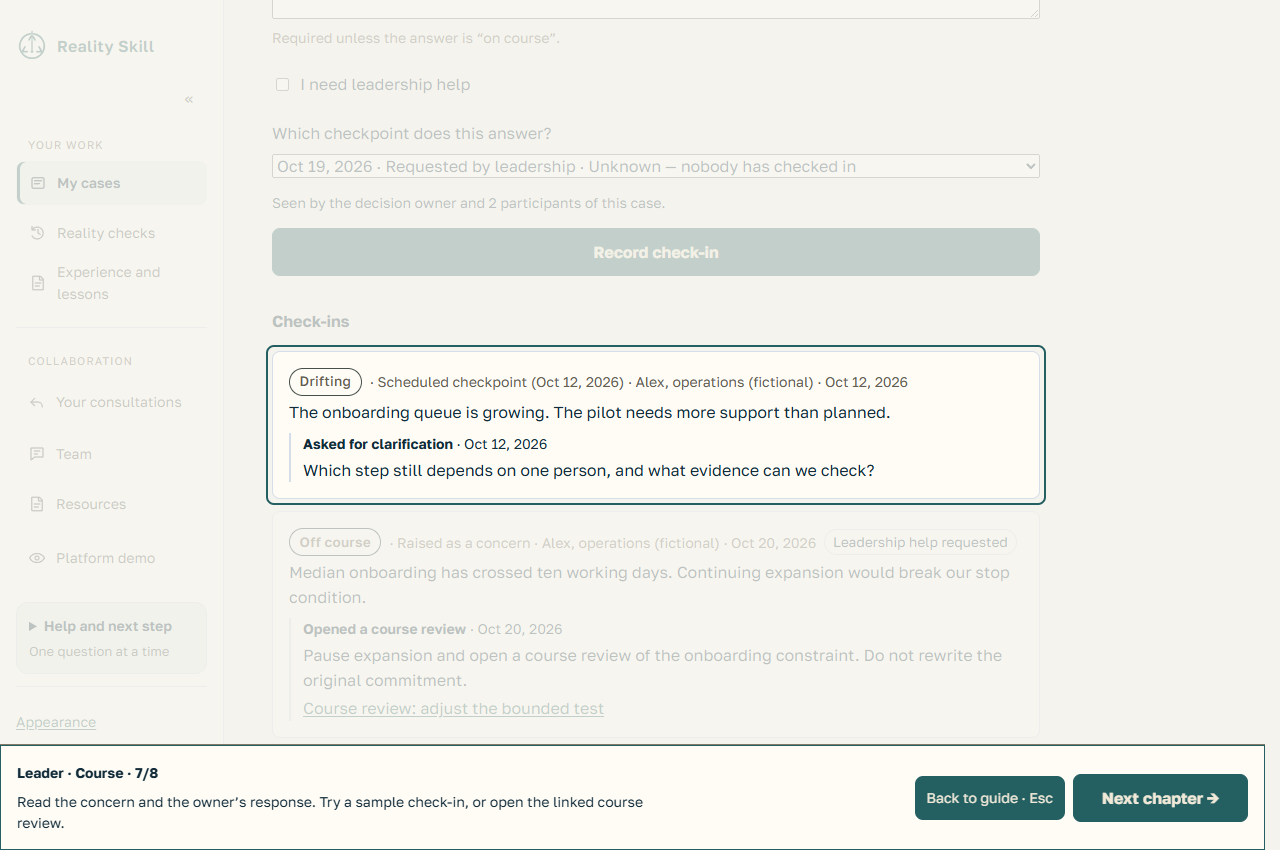
Explore follow-through in the demo
Actual app screen · fictional sample company and prepared events, not a customer result.
  • Set dated checkpoints before the final review, or raise a concern when something changes.
  • Record a quick check-in: on course, drifting, off course, or unable to assess. Explain what changed and request leadership help when needed.
  • The owner side can continue, ask for clarification, or open a linked course review without rewriting the original commitment.
  • Find outstanding updates in the relevant attention lists, review agenda and calendar feed.
Explore follow-through in the demo →

Personal checkpoints are included in free access. Company and advisor oversight follows existing permissions. These are human-reported updates, not automated project monitoring, email alerts or a guarantee of success. Ordinary check-ins are not anonymous protected feedback; their audience is shown in the app.

More ways to reach a useful decision

Capture first. Organize when ready.

Write or paste your information without classifying every sentence. Optional AI organization proposes statements and labels; you review what to accept.

Personal and Company · AI availability and usage limits apply.
Find a better route, systematically.

Step back from a proposed solution to the goal, separate conflicting requirements, or turn an objection into a design condition. Save a candidate before deliberately adopting it as an option.

Personal and Company · the guided exploration itself makes no AI calls.
Keep unfinished writing.

Supported signed-in writing forms save private drafts while you type. Saving a draft does not submit, share, commit or send the writing to AI.

Requires a working connection for server saves; check the save status. Guest forms and uploads have different limits.
Hear beyond the core team.

Company Consultation gathers input from 8–100 invited company members without expanding the 2–7-person Team Room or transferring decision authority. Track unresolved contributions and owner responses.

Company workflow · named or anonymous-to-audience input, within its access rules.
Protect dissent, with accountable moderation.

Authorized participants can use protected feedback and later choose to reveal authorship. Eligible moderators can hide abusive content with a recorded reason and a reconsideration path.

Company leaders have no authorship lookup. Context may still suggest identity; this is not anonymity from infrastructure operators.
See what needs your advice.

Advisors can review current requests, client replies and follow-up requests across authorized engagements. Follow-through attention is limited to explicitly shared cases.

Advisor access requires admission and current client authorization; browsing the demo grants neither.

Questions, answered

What people usually want to know.

Is Reality Skill a project management tool?

No. Reality Skill supports the reasoning before a commitment and the human check-ins afterwards: record changes, respond to concerns, and adjust course before the final outcome review. Detailed task and project management stays in your existing tools.

Does the AI make the decision?

No. AI can help structure material, surface questions, or challenge a case. A person must accept changes and remains responsible for the decision.

What does the Company licence add?

It adds company-owned decision records, Team Rooms, named decision rights and approvals, leadership oversight, organization playbooks, assumption and dependency monitoring, review packets, and company AI controls within the agreed rollout.

For your leadership team

Make better decision practice part of company operations.

See the platform in action, discuss an organization license, and identify an initial decision your team can work through.

Request a platform demo